#8 ‘Monochrome and Malfunction’ by David Batchelor

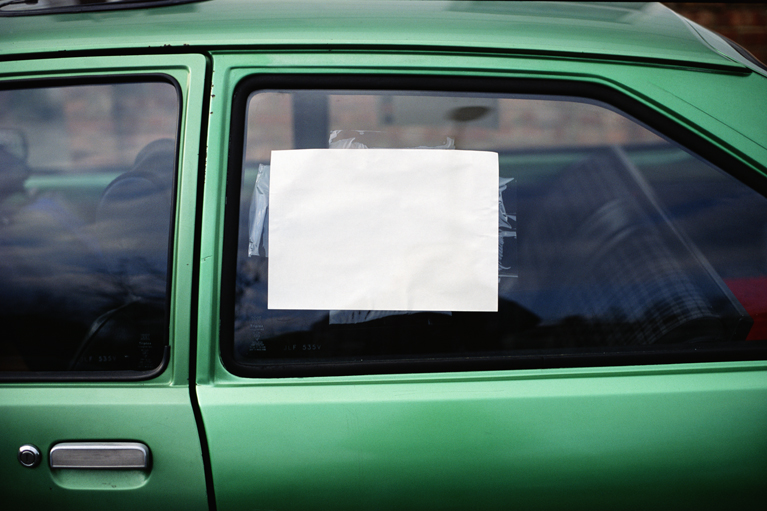
Found Monochrome No. 19, Islington, London, 10.04.99,‘ by David Batchelor.


There is something about Found Monochrome No. 19, Islington, London, 10.04.99 that I have always liked, but I have never been exactly sure why that is. There are a number of things about it. I didn’t have to travel far: it was literally on the street directly outside the studio I worked in at the time, a vaguely run-down residential street in north London. The car was an old Vauxhall Chevette and I assume the rectangle of paper taped to the inside of the rear window was a handwritten ‘for sale’ notice that had faded in the sunlight. Everything about the image is both commonplace and provisional: the car parked just where it was at the time, the homemade sign, the wrinkled and uneven Sellotape, the non-lightfast ink, the here-today-gone-tomorrow everydayness of an improvised urban event gone slightly wrong.

In November 1997 I began talking photographs of blank white rectangular panels that I found in the streets around where I lived. At the time of writing, August 2012, I have shot just over five hundred such images. The majority were found in London, because that is where I spend most of my time, but I have come across others in town and cities – almost always towns and cities – elsewhere in England, Scotland, Continental Europe, North and South America, and Asia.

A number of things have changed in the sixteen years between the first and the most recent photograph: for example analogue photography has almost entirely given way to digital media, although I continue to use film for this work. There are a few reasons for this: pure habit and my love of carousel slide shows being the main ones. The main change within the project however is that my reasons for starting out bear almost no resemblance to my reasons for continuing. I only ever intended to take four or five images of these things I called ‘found monochromes’, and I took them initially in order to disprove or at least question something Jeff Wall had claimed in a lecture on On Kawara and the monochrome. This argument I conducted mainly with myself ceased to have any part in my thinking after I took the first few images.

These monochromes of the street are occasional, often inadvertent and always temporary. They are little heroic moments of blankness in an otherwise saturated visual landscape. It is an ambiguous blankness because rectangular planes of nothingness could also be seen as voids at the centre of the field of vision. As such they are like errors: a space where there shouldn’t be a space, an absence where there should be a presence. And, soon enough, these errors are corrected: removed, painted over, filled-in or tagged. So a monochrome usually has a short life-span; over a few days it comes into being and it passes away, usually unnoticed. I never know where or when a monochrome will occur, except that they usually crop up in more transitional neighbourhoods and generally don’t feature in the more carefully tended areas of a town or city. Looking back through the original transparencies I realise I remember nearly every occasion that I photographed – and each feels like an incident that was recorded as much as an object that existed.

I have never thought of these works as photographically significant: if the monochrome is landscape, the photograph is landscape; if the monochrome is portrait, so is the photo. I simply frame the event, centre the monochrome, make sure it is parallel to the picture plane and leave enough space on each side. Each image is a document; the series as a whole is a narrative of visibly imperfect repetitions, and a map that indicates the locations of incidental things that are no longer there.

For all its informality and contingency, No 19 is formally quite succinct. The white rectangle is framed and isolated by the largely dark interior of the car; there is a bit of depth in the space behind the glass; the chipped metallic green of the car body frames the event in an abstract kind of way. It is a simple picture of three surfaces, all of which require and sustain each other, and there is nothing else. The metal supports the glass that supports the paper. The paper behind the glass calls attention to the metal that it advertises, or fails to advertise: the intended relationship – the purposeful but entirely un-aesthetic placement of materials in relationship to one another – has come undone, has slowly dissolved, along with the ink that is no longer there. In doing so, it has become something else. A malfunction has become a monochrome.

David Batchelor is an artist and writer based in London.

#7 ‘Venus of Truson (prehistoric, photogrammic original), 2011’ by Nathaniel Mellors


This photogram is mysterious. It seems to retain as much as it gives away. Slipping into a kind of hippy vernacular I’d say it looks like there is a kind of ‘cosmic birthing’ going on. If you can accept that, then I’d like to suggest that this may be because the photogram production process involves something fundamental to image generation. It is almost like the DNA of photography [1], and it seems to contain photography’s primary mechanics. In that respect it conveys a depth which I can’t summarise without mystical invocations. But there is a back-story to the creation of this print on which I’d like to elaborate – it’s the cosmology of a series of photograms made in a Yorkshire cave. [2]

I’d been to see the Shadow Catchers: Camera-less Photography at the V&A in 2010 and was underwhelmed by the majority of the works in that show, many of which seemed to simply illustrate a simple methodology. But there were also a few quite different works there which caught my eye. These were ‘chemigrams’ by Pierre Cordier, made with home technology  (margarine, hair gel, photographic paper) and the results seemed to completely transcend their production: unlike most of the photograms on display these works seemed to invest more in the chemical possibilities of the development process than in the moment of exposure. There was something remarkable and magical about them. My friend Chris Bloor and I then discussed the idea of developing our own photogram production techniques that might combine experimentation in both the processes of exposure and development of a photogram of a particular object, with a specific history – that object being a badly sculpted copy of the Venus of Hohle Fels which appears as a prop in my video series Ourhouse (2010 – ongoing). [3]

The real-life Venus of Hohle Fels is the oldest undisputed example of figurative art in the world. This is an object that certainly withholds more than it gives up; people have been projecting history and meaning onto and about it since its discovery in 2008. Personally, I like the idea that it is  –  for now – the primary and therefore most authentic artwork: a kind of ur-sculpture. In his 2010 film Cave of Forgotten Dreams, Werner Herzog, under the influence of Jean Clottes and other writers on prehistoric art, talked about the idea that prehistoric artefacts from this era evidence self-awareness and therefore can be seen as objectifying the dawn of human consciousness. So the Hohle Fels sculpture is like an avatar of an emergent self-awareness – out of the darkness: light, the birth of the idea, the appearance of caveman-lightbulb above caveman-head.

This print [above] and 97 others were made, manually, in Chris Bloor’s bathroom and study, in his house in Baildon, using crude equipment –  torches, color-gels, acetates, developing fluid, a darkened room – shining light at and through my fake of the world’s oldest figurative sculpture.

In the Ourhouse story my friend David Birkin plays Truson, who is one of the main characters. Truson is a person who cannot lie. His name is a conflation of ‘true son’ [4] and he represents a variation on the ‘holy-fool’ archetype, a kind of savant who exposes the pretence of other characters relative to his own innocence. He is almost mystical in this sense, a truly beatific person. Truson has ordered the fake Venus on the Internet and it arrives at the house by post [5] near the beginning of Episode 1. To the viewer and to the other characters in the story, the sculpture that arrives is transparently un-prehistoric. It is a modern fake, at least five times larger than the original, newly and crudely manufactured on a band saw, leaving it with an anomalous and clunky cubic aspect. But Truson cannot conceive of the idea of something being fake. He engages with reality on a primary, ontological level; everything that is, is equally real to him. So for Truson his Venus is entirely authentic; it simply is. And when any other character in the story describes the Venus as looking ‘fake’ he becomes confused and distressed.

The idea of the fake Venus is a running joke – a joke on the art-historical authenticity of the object, a joke on the subjectivity of idolatry and a joke on the contextual and referential strategies used to inscribe value in contemporary art production. I am engaged in a parallel process, using my scripts and films as a combined locale and rationale for the production of work in other forms.

This rationale forms the basis for all of the Venus of Truson photograms, including those that appear completely abstract. We have produced 97 photograms across four series, each on a different scale. The process is unpredictable: each print comes out quite differently and is a completely unique artefact. This photogram is the tenth print in Series #4. It is the 90th photogram we have made. Series #4 are all really big and they are folded prior to development – we didn’t have a bath big enough to develop them in, so they ended up acquiring an extra-sculptural dimension. All of the photograms in this series involve a play on the authenticity of the contemporary art object in relation to pre-history and modern modes of reproduction.

We made these ‘bullet-point’ notes [6] for the first exhibition [7] that included the large-scale, folding photograms, at the Cobra Museum, Amstelveen, last December:

Local History / Amateur Archaeology:

1. We contemplate a return to the cave.

2. All of the photograms are made by hand in total darkness.

3. The photogrammic production process is chemical and unstable, resultantly each print is unpredictable, analogue and unique.

4. These colour photographic development techniques are themselves: prehistoric to digital culture.

5. The photograms incorporate movements between subject and object, (pre-) historic and contemporary, instinct and technique, darkness and light, original and fake.

6. The photograms reassert their subject’s authenticity; they objectify it.

7. Ontological ping-pong: the entire Ourhouse film/video series and its ‘movements’ (see 5.) between points of formal and conceptual opposition can be read as an absurdly complicated way of making a series of prints, i.e. through the reverse lens of the photograms the Ourhouse film/video series becomes an elaborate projector for a different form of artwork.

The photograms are born, subject and object, out of the Ourhouse script. I don’t think we will make any more based on this particular object. I like the idea that they have their own time; 2011–12. What I am most interested in is a methodology that is a form of studio production determined by an original script and video series; it is a mode of conceptual art which is both pre- and postproduction. It is before and after sculpture.

————-

1 A photogram is a form of camera-less photography, an unique print made without a negative by directly exposing an object to light-sensitive paper. Photograms have been fundamental to the development  of the photographic medium – Anna Atkins’ 1847 book British Algae: Cyanotype Impressions included her botanical photograms and was the first book to be illustrated with photographic prints of any kind. In the 20th century, Man Ray’s direct exposures of familiar objects established a popular archetype for the form. Pablo Picasso, Laszlo Moholy-Nagy, Len Lye and many other artists have made photograms in different styles, using varying techniques.

2 in the bathroom in Chris Bloor’s house, near Baildon, outside Leeds, inside Yorkshire.

3 I’ve erroneously described this series as ‘absurdist’, suggesting that Ourhouse is a work made in a specific form. To be more precise Ourhouse is an artwork exploring the coalescence of language, power and form with some absurd results.

4 He is the first son of ‘Daddy’, Charles Maddox-Wilson (played by Richard Bremmer), middle-class-artist-alchemist, counter-cultural-remnant, patriarchal centrifuge and owner of the house.

5 The ‘post-box’ in Ourhouse is dematerialised; it is a hedged area at the border of the property. The inside and the outside of the property are symbolic entities. Truson has to furtle in the undergrowth to collect the mail.

6 In the mannered register of an artist’s manifesto.

7 Nathaniel Mellors – The Nest, Cobra Museum of Art, 10 December 2011 – 4 March 2012.

————-

Nathaniel Mellors was born in Doncaster in 1974. He studied at the Ruskin School, Oxford University (1996-99) and the Royal College of Art, London (1999-2001). In 2007-09 he was resident at the Rijksakademie van beeldende kunsten, Amsterdam. The manipulation of language is a core theme in his work. In addition to his script-writing, film, video, performance, collage and sculpture, Mellors is/ was a member of the groups God in Hackney, Advanced Sportswear and Skill 7 Stamina 12. He is a co-founder of Junior Aspirin Records. He lives and works in Amsterdam & London.


#6 ‘Two Film Stills’ by David Campany

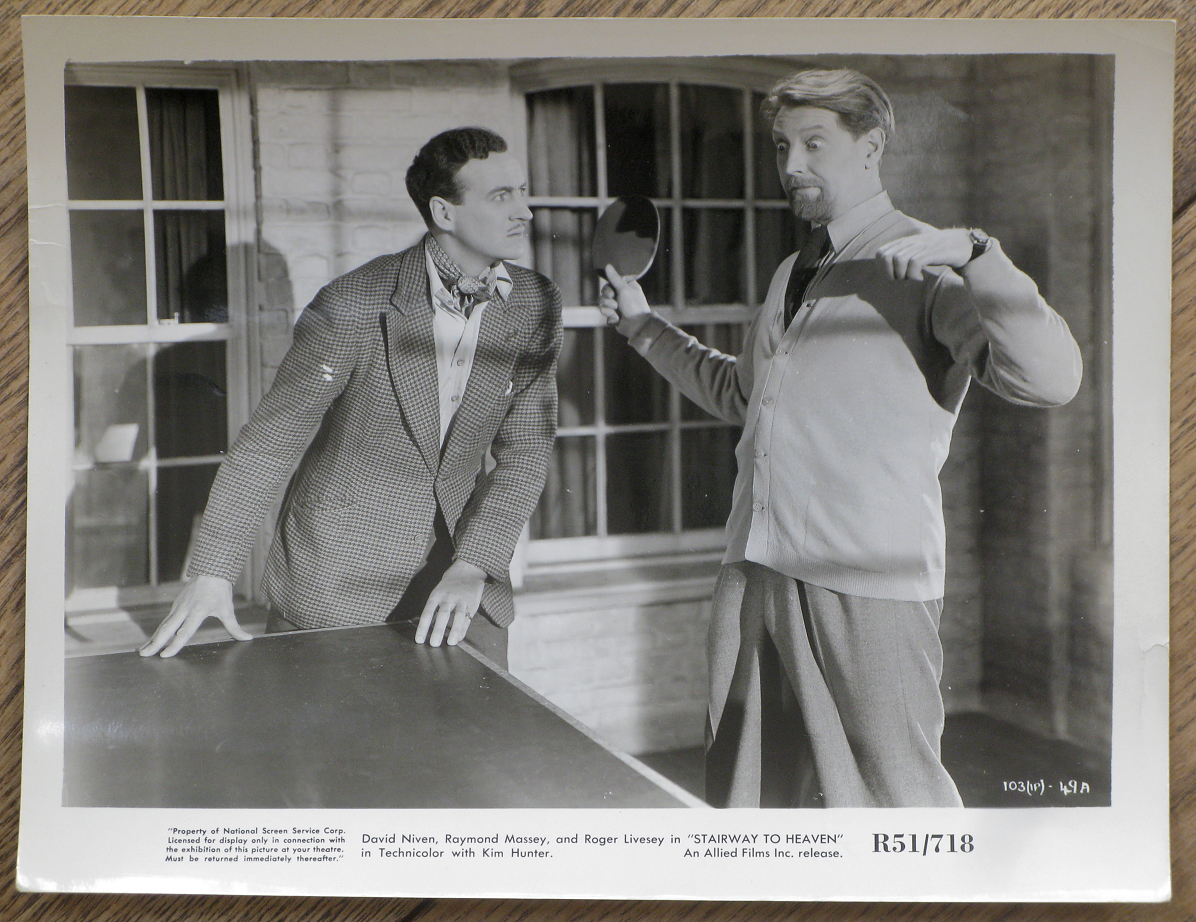
Here are two very different publicity stills from two very different films. Michael Powell & Emeric Pressburger’s A Matter of Life and Death (1946), which I watch often, and Robert Bresson’s Mouchette (1967), which I saw only once and will probably never see again.


A Matter of Life and Death (in America it was titled Stairway to Heaven) is a very English fantasy film. David Niven plays Peter Carter, a Second World War pilot shot down over the English Channel. Leaping from his flaming aircraft he doesn’t die but washes up on a beach. He soon falls in love with the American radio operator (played by Kim Hunter) to whom he thought he’d given his last words.  But he may have been affected psychologically by the brush with death: he begins to have hallucinations in which the world around him is temporarily suspended while a messenger appears from the afterlife to summon him. He should have died. In this suspension Peter argues with the messenger that he’s now in love and therefore cannot be summoned. His girlfriend and his doctor try to monitor these hallucinations. While Peter sleeps in the adjacent room they play table tennis. Suddenly they freeze. Peter wakes up. He knows the messenger is here. He rushes next door to tell the doctor but finds him immobile. Peter stares at him.

You can watch the scene here:

http://www.youtube.com/watch?v=-sbjD9SpiRo&feature=relmfu

Now strictly speaking, I guess this scenario shouldn’t ‘work’ as a still photo. How can you show an animate person looking at a frozen person when the photo freezes everything? But somehow it does work. The doctor’s body is so contorted, while Peter’s stare is that of a man poised with cogent intensity. It’s quite a grotesque photograph, like a punch-line for a missing joke. I watch the film often but I rarely look at this image. Nevertheless once seen, it is not forgotten. I don’t know of any other photograph that expresses this very unusual sense of time.


I saw Bresson’s Mouchette several years ago and I’ve never been so moved by a film. I was shaking when I came out of the cinema. It’s about a young adolescent girl, the Mouchette of the title, whose poor life in a rural French village is hard. Her father is an alcoholic and her mother is very ill. She looks after her younger brother and does all the housework. She is teased and tormented at school, and ostracised in the village. Despite moments of joy there’s really nothing but pain and tragedy in her life. She seems strong enough to deal with her lot. One morning she is by a river. She rolls herself down the bank in her shawl and is stopped by a bush at the water’s edge. She seems to be doing it for the dizzying little pleasure. A stolen moment of abandon. But she does it again, this time rolling into the river to drown herself. It’s the last scene. Mouchette should be a ‘coming of age’ film but she doesn’t get that far.

At a fleamarket in a French village last summer I found this photo and I treasure it, both as a beautiful picture and as a memento of a film I don’t think I can bring myself to watch again. I can think about Mouchette’s fate without having to put myself through it.

Both of these photos were taken by stills photographers. Almost every film production has a stills photographer. Stills provide the movie with everything from working descriptions of interiors and locations to archival records. And of course they are made for publicity purposes. After the director has a take in the can the actors may be called upon to repeat their performance, ‘once more for stills’. What is performed firstly for the cinematographer is performed again for the photographer.

Movements must be converted into stillness. The transfer is not always as straightforward as it might seem. Actors need to be posers too, but the essence of an unfolding scene may not be achievable in a single shot. The art of film acting is above all the art of movement, one might think. Stillness may deprive the actor of their métier.

In the case of my two examples the problem is even more complicated. The photographer on the set of A Matter of Life and Death had to quickly work out how best to present as a single image a form of stillness that really requires movement. Robert Bresson had a very different attitude to cinematic performance. He disliked the idea of actors and preferred non-professionals in his films. He avoided even the term actor and all its theatrical implications. He preferred the idea of the model, a term that recalls the still photograph or the painter’s studio. He had his models drain themselves of theatre, insisting they perform actions over and over in rehearsal. Finally they could perform before the camera without thought or self-consciousness. Bresson writes in his only book Notes on the Cinematographer (1975):

No actors. 

(no directing of actors)

No parts.

(no playing of parts)

No staging.

But the use of working models taken from life.

BEING (models) instead of SEEMING (actors)

Later he notes “Nine-tenths of our movements obey habit and automatism. It is anti-nature to subordinate them to will and thought.” The result is a style of performance in which both everything and nothing looks controlled. The ‘models’ perform with an inner calm and apparent stillness, even when moving. They ‘go through the motions’, we might say. Unfairly described as austere, the restraint in Bresson’s films can seem unapproachable but absorbing too.

One task of the stills photographer is to condense and distil a filmic scenario into a readable image. Gestures are altered, body positions are re-organised, and facial expressions are held. Often the lighting is perfected, wayward hair and clothing are groomed so as not to distract and the camera focus is pin sharp. Caught between cinematic flow and photographic arrest, the classical film still has a unique pictorial character.

Even today individual film frames are of low quality. The film grain is coarse and the image may suffer from motion blur or loss of focus. The richness and precision of the moving image we see on screen is in part an illusion, conjured by the real time projection. Flashing up, twenty-four frames per second, our visual pleasure derives from a constant tease. Always shifting, always changing, it is forever out of reach. It can never be trapped and held. The stills photographer can suggest movement but cannot recreate it. The static photograph made on set requires something else. It must satisfy the desire for fixity. The still photo must hold the stilled gaze.

In the 1920s the silent movie was perfected. The 1930s then saw the introduction of sound. Styles of acting began to change. No longer did physical gestures need to carry everything. A line of spoken dialogue could be enough to energise a scene. The arrival of sound also changed the relation between cinema and the still image. Silent film had a secret affinity with the silence of photographs. Both were voiced by text  – the inter-title, the caption. The ‘talkies’ interrupted that. Just as the arrival of cinema’s movement made photographs look still, the coming of sound emphasised their muteness. Thinking about it now, what I like about these two photos is that they come from moments in their films that are nearly silent.

In this transition cinema became a truly popular form and a systematic industry. The finest technicians were under contract and the filmic image became a source of beauty, of desire, seduction and spectacle. Also, cinema became a popular art when mass media magazines were dominant. It was here that the film industry and the popular press began their co-dependence. Magazines carried publicity for the movies – advertisements, portraits, profiles, gossip, previews and reviews. They were also the home of photo-reportage. The crafted film still and reportage might at first strike us as total opposites. After all, cinema had already become an escapist world of fantasy while the subject of reportage was actuality, the real events of the world. But each in its own way had to solve the same two problems: visual clarity and narrative stillness. Film stills achieved it through staging and the use of large format cameras. Reportage took another route, a picture taking rather than making. It elevated quickness, lightness, mobility and economy of expression. The technical tools were minimal and immersion in the changing world was the key. Motion would be frozen in fleeting frames by solitary photographers working with the Leica camera. First introduced in 1925, it was small, neat and portable. It used the 35mm film that had become standard for the movie industry. Where cinema celebrated movement by recreating it, reportage celebrated by suspending it. Searching for beautiful and symbolic geometry, the photo-reporter would pounce when the world appeared to be organised momentarily as a picture: the ‘decisive moment’. And where the film still staged arrestedness, reportage used fast shutter speeds to freeze it. Both sought to trap fleeting detail and to halt time. And both pursued, as the artist-photographer Jeff Wall put it, ‘the blurred parts of pictures’. The image from A Matter of Life and Death corresponds with this classical idea of the film still, but Robert Bresson was after something else, something less polished and more direct. Stills from his films often have the look of seemingly casual photographs or reportage. Imperfect and spontaneous.

Today the close analysis of films is open to anyone with a DVD player, or access to the internet. A movie can be watched as a whole or as a set of bits and pieces – scenes, chapters, freeze frames, alternative edits. To some extent we are all film theorists now. To watch is to analyse. Meanwhile the DVD has given a new life to the film still in the form of ‘picture galleries’ that are frequently included as extras.

As a result our viewing habits and therefore the making of films has changed. Contemporary films expect to be seen in pieces.  And it seems to be those filmmakers from the past whose work stands up to this repetition and fragmentation that are valued today. Alfred Hitchcock is the obvious example but one could also include Powell & Pressburger. I can watch any part of A Matter of Life and Death and enjoy it. In many respects the film is an elaborate string of set-pieces, perhaps less than the sum of its sublime parts. Mouchette is quite the opposite. In parts it is nothing.


David Campany is a writer, curator and artist. His books include Art and Photography (Phaidon, 2003/2012); Photography and Cinema (Reaktion, 2008); Jeff Wall: Picture for Women (Afterall / MIT press, 2011) and Walker Evans: the Magazine Work (Steidl, forthcoming). He has published over 200 essays and writes for Frieze, Aperture, Source and Photoworks. In 2010 he co-curated Anonymes: unnamed America in Photography and Film, for Le Bal, Paris. His photographic work was shown recently at Kracow Photomonth.


#5 ‘An Octopus Walks into a Bar’ by Doug Fishbone

There is an old logistic syllogism that states:

God is Love.

Love is blind.

Ray Charles is blind.

Hence…

Ray Charles is God.

An interesting conclusion to be sure. But what about Stevie Wonder? Or George Shearing, for that matter?

An argument like the above can only work under the vaguest guidelines for definitions or categories. No one would ever attempt to convince anyone of anything – with any degree of seriousness – using such glaringly shabby reasoning.

Now imagine an advertisement for cigarettes featuring a famous actor.

Famous actor smokes Marlboros.

Famous actor is rich and sexually fulfilled and happy.

I smoke Marlboros.

Hence…?

Strangely, this kind of claim is much less absurd when expressed in visual terms. We see such things all the time, in any advertisement using a celebrity endorsement, to such a degree that we rarely pay attention to the implications.

Images can transfer something beyond themselves, beyond what it is they purport to represent, in the murky realm of visual rhetoric.

How do we speak to each other visually? Can we compose legible visual statements that articulate things more poetically, powerfully or playfully than the spoken word alone? It seems we can, if advertising and propaganda are anything to go by.

“Why must it be,” asks film theorist Christian Metz in Film Language: A Semiotics of the Cinema, “that, by some strange correlation, two juxtaposed photographs must tell something? “ Metz asserts that going from one image to two images, “is to go from image to language.” Yet a grammar or syntax of images works differently from a verbal one, since the basic units are themselves inherently unstable. Images, even more than words, are subject to radically different interpretations depending on who sees them and in what context.

What sense would an image of Jade Goody, or Jedward, make to an Amazonian Indian who has had no contact with Western culture, and hence no notion whatever of the cultural context? Or to people in London a few years’ time, when such monstrosities will have disappeared form the collective consciousness?

As communications scholar Paul Messaris notes in Visual Persuasion, “what visual communication lacks most crucially is a so-called propositional syntax.”

But this is where the fun begins. Because if an image can be interpreted in such a wide range of ways to begin with, then many different aspects of it can it be referenced in interpretation.

In this excerpt from my video Hypno Project (2009), which looks at questions of relativity of perception and media influence through the prism of Cold War paranoia in the US, a spoken-word monologue is accompanied by a rapid series of images flashing before the viewer in a slide-show format, like a hyperactive visual stream of consciousness.

An image of a Soviet missile launcher, poised to fire, is followed by a still from the American slasher film Halloween. The killer is holding his knife at the exactly the same angle as that of the missile, creating a distinct visual rhyme to the image preceding it. Next, we see an image of a Soviet tank on parade, barrel pointing menacingly, again at that same angle. Without needing to verbalise it, a proposition can be articulated thanks to the formal similarities and connotations of each individual image: at the end of the day, was the fear of Communism merely something theatrical?

In another passage, a heroic painted portrait of Joseph Stalin in uniform is followed by an almost identical photographic image of Saddam Hussein, also in uniform. Both are  traditional propaganda images. The formal similarities between them create another distinct visual rhyme that again offers a proposition rooted in inference and association  –  the Muslims have replaced the Communists as the bugaboo of the West.

Then, in rapid succession: Soviet troops marching; a swarm of killer bees on the poster of a paranoid American movie; a colony of fire ants; two images of Mexican immigrants jumping the border; a set of dominoes; and another movie poster, this time from the film Them, one of the classic paranoid sci-fi thrillers of the Cold War era. The proposition: Americans are a paranoid bunch given to manufactured enemies. More specifically, their fear of Communism is part of a broader phobic complex that can be linked psychologically – vermin, immigrants, invasion, threat.

An expressly visual argument is being presented, based on the ability of images to carry numerous meanings and connotations simultaneously, to resonate referentially. One could make the observations more clearly in a verbal statement, but the visual rhetoric allows for something interesting and more poetic to unfold – an attempt, perhaps, to reflect the thought process itself. It is a way to articulate how the mind works – blurring images and impressions, reflecting the imprecision of a mind that sees threats everywhere. Or on a broader level: a way to articulate how the mind draws connections in general – the process by which one thing reminds us of something else, or one thought leads to another.

Speaking of which, here’s a good joke.


Doug Fishbone is an American artist living and working in London. 

#4 ‘Room 125, Westbank Motel, Idaho Falls, Idaho, July 18 1973’ by Michele Robecchi

‘Room 125, Westbank Motel, Idaho Falls, Idaho, July 18 1973.’ by Stephen Shore.


It looks like the most casual of snapshots, the illustration of the rigour and anonymity of a motel room after a long day of travelling – the classic image that American photographer Stephen Shore has been known for, since, in the early 1970s, he decided to embark on a series of road trips from New England to Texas with the intention to create a visual diary of his journey by documenting meals, hotels, petrol stations, cars and the whole set of characters that populate that vast and somehow uniform part of the country, filling the distance between one big urban centre and another.

Then, at closer inspection, the initial impression slowly begins to unfold. The stretched legs of the author on the bed don’t match the position of the camera, which, significantly, has been set up on a tripod beforehand; the view outside the window has been studiously washed out, but a tiny version of the exterior landscape is visible, reflected on the television screen overhead, juxtaposed with images coming from the flickering black and white TV set; and finally, the late afternoon lighting is vividly present, unfiltered from flash bulbs, bathing each corner of the space and highlighting its natural colours. Even the square format of the picture, distant from the standard postcard frame that characterized Shore’s previous efforts, seems to reflect a change, with the subtle gap between the position of the photographer and his camera, indicating the frustration for what is regarded as an evident perspective limit.

‘Room 125, Westbank Motel, Idaho Falls, Idaho, July 18 1973’ is part of ‘Uncommon Places’, Shore’s second colour series after ‘American Surfaces’, and the first one featuring a 4×5 view camera – a rather unpopular device in the 1970s. It follows his traditional method of naming his photographs according to location and date, but rarely a title could have been more misleading. An attentive glance gradually erodes the protagonist status of the room to disclose what is fundamentally a self-portrait – that particular moment of introspection and reflection that artists occasionally feel compelled to capture.

Photography entertains an ambivalent relationship with reality. It is an argument that has kept some of the finest minds busy since the arrival of the medium. Shore himself has touched on the subject in several of his interviews by declaring that to a certain degree photography will always be a semi-fictional representational form due to the photographer’s decision-making power on when and how to shoot. It’s a logical if not simple explanation, but one that doesn’t quite settle the issue in a fully satisfactory manner, especially when matched with the carefully choreographed qualities of ‘Room 125, Westbank Motel, Idaho Falls, Idaho, July 18 1973’. Far from being a passive interpretation of reality, Shore’s photograph deliberately hides itself behind a smokescreen of ordinariness to mine the perception of the viewer, calling into question his/her role, as well as the one of the photographer, in determining the nature of the subject. In this picture, the common notion of the role of the photograph as a truth-revealing instrument is quietly but authoritatively challenged from the inside out, simultaneously staging all the restrictions and advantages of the medium.


Michele Robecchi is a writer and curator based in London. A former editor of Contemporary Magazine (2005-2007), he is currently an editor for contemporary art at Phaidon Press and a visiting lecturer at Christie’s Education. He regularly contributes catalogue essays and magazine articles for publications such as Art in America, Flash Art, Interview, Kunst Bulletin, and Mousse, and is the author of a monograph on the work of Sarah Lucas, published by Electa in 2007.

#3 ‘April Kool’s Day, 2005’ by Emer O’Brien

April Kool’s Day, frame 5, 2005, by Emer O’Brien.


I have been a stranger in a strange land. A vagabond amnesiac, Walter Benjamin might claim. In I-creation* Hackney Wick had transformed into a semblance of an antique excavation, with ruins, a sacred place with an entrance to the underworld. Viewed through my lens, this vast playground regained something of the original terror; or as Benjamin has noted: a track that carried with it associations of the terror of wandering. In my mind associations or traditions upheld by urban flâneurs and many great photographers both past and present allowed the residual power of a photograph a place to linger somewhere between the past and the future on the edge of the great beyond.

Frame 5 depicts an empty field, a static car and a well-worn path. I am reminded of Richard Long’s show ‘Heaven and Earth’ at Tate Britain in 2009. I too often embark on long solitary walks, losing myself briefly but continually documenting the process on film. Not just places but points in time are captured on a single roll of film and exist like a tangible trail of white pebbles in the forest or a way in and out of my memories.

A desire path is powerful. As a social concept it is capable of repressing urban alienation and social estrangement by commanding a following with the comfort of little resistance. On this day I contemplated the inhabitants of Hackney Wick and a city too rapidly transforming to comprehend in traditional terms. In retrospect my observations seemed to foreshadow a site now virtually unrecognisable as the Olympics approach. But in the present that was, I merely concluded that the creatures that lived here were only intermittently human and therefore transient by nature. Where could this car take you? A journey through a wormhole to another dimension perhaps. I turned back the way I came and continued my quest for physical clues and an understanding of the social conditions of Modernity.

This was April 2005, it was a cold day in springtime and the snails were fruitful. They increased abundantly and multiplied and waxed exceeding mighty and the Eastway was filled with them. As traffic spun out crossing the A12 their individual details were absorbed into a larger constellation of sight and sound. I couldn’t help wondering what this mass molluscan exodus meant. Where were they all going with so many homes tethered to their backs? I walked on, through certain tribulation and mindful of the gaps.

Meanwhile back in the beating heart of Hackney the Outlaws and Rig Doctors** confronted our corrupt and decadent society. On bank holiday weekends the airwaves were often highjacked by pirate broadcasting. These transmissions seemed to provide shelter for the transient and the disconnected. In the distance a man was breaking vinyl with his sledgehammer. To his right, the biscuit tin, still warm with inspiration and the battle cry of Modernism. It was CRCA and they have considerable powers of confiscation. They take music, the most tangible and residual form of urban alienation. I wondered what the future of pirate radio was, the last bastion of analogue communication. And I saw connections between my solitary walks, their solitary voices and vehicles that transcend space and time whether symbolised in the journey of a snail, a burnt out car, or materialised across the airwaves.

I no longer know the way back to Hackney Wick. Probably because the path keeps changing – more rapidly than a man’s heart, the type of change Baudelaire’s lamented many years ago, mourning for his lost city, Paris.  But I can remember this day and my journey through the frames on this roll of film by the process of spatial dissolution. I can find the old entrance to my old studio on Wallis Road and the way through the gate, the small doors, the workplace, the corridor, the room and up the ladder and into the rafters. I can remember my studio was warm from the incineration below: warm like the biscuit tin. I can remember the drone of the music from the party on this little island and how I just about hung on. Looking back maybe I was dreaming but the sound of my camera dropping like a pound press on that table still resonates and the morning after remains. It was Good Friday 2005, so I walked out into the light.


Post Scriptum

April Kool’s Day: April 1st 2005 Hackney Wick, 2005. This was the name of the bank holiday party advertised on Kool FM.

Some years ago I had a studio in Hackney Wick. What I remember most vividly about that time was the pirate radio stations and the bank holiday parties often connected to them. Kool Fm would interrupt the BBC London frequency and I would wonder what happened to the world I knew. It was like time and place had disappeared. My studio was in an industrial park and in a joining building a party was spinning out of control. When fleeing promoters fell through the rafters of my space I found myself tangled up in the onslaught. My camera still bears the proof as an officer shacking out the contents of my bag back onto a metal table back at the station.

*i-ration. pron.(i-rai-tion) 1.  Rastafarian term that emphasis subjective involvement in universal creation. 2. The Rasta way of using the word creation. The letter i is used to refer to god, and all people. In Rasta culture i is used to denote god, you, me, and everyone or i, i, i, and i.3. The Rastafarian state of mind, from which, one is absent of the world, but within the self; only to be achieved by inhaling holy smoke.

** Rig doctor. n. 1. Someone that builds pirate radio transformers, often hidden when placed outside in biscuit tins.


Emer O’Brien is a Canadian artist who lives and works in London. 

#2 ‘Exploding Hand’ by Richard Wentworth

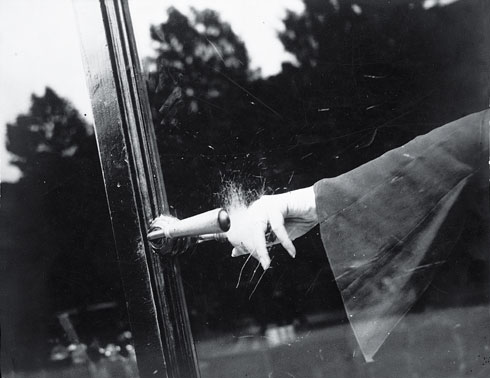
Untitled (Exploding Hand), c. 1930, by Lee Miller.


Thirty years ago in provincial France I frequented a quincaillerie whose proprietor was a Monsieur Tardy. In the days when I still did not grasp the precision of French opening hours, I would often miss my pre-midday opportunity with M. Tardy. Once, approaching on the narrow pavement, reaching for the door handle  (the classic lever pattern), I was astonished to find the handle was no longer there, and the door was locked for ‘midi’. On a more successful visit M. Tardy showed me how the handle could be taken off and added as a temporary extension to the inside handle for safekeeping. The sight of the absent handle continued to send the perfect Duchampian message until Tardy retired and his fine store became a gift shop.

Why humans make images, how we store and retrieve them, and the way they become shared language is a particular preoccupation of artists. It is unsurprising that M. Tardy and the disturbed glass of Lee Miller’s Untitled ( Exploding Hand) photograph cohabit in my mind. Miller’s picture, which I am not looking at as I write  (the better to value it as an image), contains a wondrous onomatopoeia. It is collaborative, noisy, abusive, scratchy, itchy, contentious, foggy and palimpsestic. It is offhand, unintended, but brimful of purpose.

The acute visitor’s eye and the Yankee technical acumen which Man Ray brought to between-the-wars Paris was the most marvelous bedding for the young and adventurous Lee Miller. The energy in her 1945 (?) * picture owes something to a hybrid of the chemistry lab optics favoured by Man Ray the conjurer, and the persistent vigilance of Eugène Atget who happened to be working down the street when Man Ray set up shop in the city.

The visual noise, and the abrasive contrast to the sexual metaphor of grasping a handle, chase each other around in this picture. Knowing, as I now do, the social and political complexities of post war Paris, the extreme positions, the suspicion, the anxieties and the accusations, the shortages mixed with heady relief, the picture grows ever richer.

I respect it as the act of an artist, prescient for sure, but not a tidy illustration of the factors in play. Like a conflict site, it helps to ‘know’ that this is where a massacre or a confrontation unfolded, but Miller’s picture with its multiple scratchings from the diamond rings of the well dressed and privileged, remains an etching in my personal file of charged images.

Like Duchamp’s phial of Paris air, this picture is scented. This small fogging of the glass, a kind of condensation after the terrible fog of war.

* The date of the photograph is in fact 1930. The stored energy in an image is perhaps not so different from the query stored in a question mark. I now discover that the photograph is much more theatrical than I remember it with almost Moholy-Nagy dynamic geometries. Already knowing something of Lee Miller’s personal story I am amused that I had moved the image forwards by fifteen years. Nonetheless, my feelings about its anxiety are just as readily located amidst the tensions of 1930, as they are with those in a later period of uncertainty.


Richard Wentworth is a British artist who lives and works in London. 


#1 ‘A photo I refuse to look at’ by Jamie Shovlin

The photograph is of a young white woman with dark hair. It’s a frontal portrait captured approximately a foot from the subject. The lighting is flat, the shadows minimal. It’s difficult to place the subject’s mood, as she appears caught somewhere between hazy diffidence and an arched smile.

These are the remaining descriptively neutral details I can recall of the photograph. For this is the one picture to which I refuse to subject my eyes and I have successfully managed not to look at it  for the last 10 years. (I did not look at it in the course of writing this text.)

The picture is an autopsy photograph of Elizabeth Short, more commonly known as the Black Dahlia. The other details that I recall of the portrait come from some place between my first, and only, experience of the photograph, and the knowledge I have, through textual sources, of the circumstances of the subject’s gruesome death.

Elizabeth Short was an aspiring actress from Massachusetts who migrated westwards to Hollywood in search of fame and fortune. Her naked, dismembered and exsanguinated body was found in Los Angeles early one morning in January 1947.  She was 22-years-old. The circumstances of Elizabeth’s murder are unclear but it is believed that before her death she was tortured, with a knife, cigarettes and a baseball bat, for somewhere between 36 and 48 hours. The cause of death is conjectured to be either a result of the extensive cranial trauma she received from sustained beatings, or from substantial blood loss as a consequence of the deep facial wounds that spread outwards from the corners of her mouth. Many of Elizabeth’s injuries, including the severing of her body into two parts, took place post-mortem. Her killer has never been identified.

I first learnt the grisly details of Elizabeth’s death through an edition of the BBC’s Arena series in an episode titled Feast of Death. The programme looked at the twin obsessions of its subject, the American novelist James Ellroy: two contemporaneous events of early 1947, the death of his mother and the death of Elizabeth Short. Each an unresolved homicide that, in Ellroy’s memory, had become a single murder.

It was also during the course of the programme, in a set-piece that saw Ellroy holding court at a restaurant table, flanked by LAPD officers past and present and, bizarrely, the actor Nick Nolte, that I had my one and only flash of the consequences of Elizabeth’s ordeal. As Ellroy recounted her story of her murder, a black and white still occupied the frame as the author’s voice coiled the table and the tale. The image features Elizabeth, twelve hours dead and framed by the silver of the autopsy table, mute as one can be, but with a face full of detail. The compressed face, half-lidded eyes, a deep permanent smile etched into her once beautiful face, all the more brutal for the absolute lack of any blood. Just bruised flesh and a record of what one person can find it reasonable to do to another.

I encountered this image in the cold bedroom of my adolescence at my mother’s house. My memory tells me I was 15-years-old but IMDb informs me that the Arena programme was produced in 2001, making me at least the same age as Elizabeth at the time of her death. These circumstances, I believe, that have gone someway towards defining my relationship with this image, this momentary flash of Elizabeth’s brutally disfigured face, thrown unexpectedly towards me in a darkened room, a room that I previously occupied and tried some of my growing up in. It caught me off-guard, attacked me in a way I no longer thought possible of images, even back then in that supposed den of warmth.

Ever since that moment, I’ve rehearsed the reconstruction of the image, over and over, mis-shaping Elizabeth’s face and her injuries through multiple visitations. Rehearsed the reconstruction of that first viewing and the unavoidable mental aversions that accompany (I have a hard time even when I smell the images’ proximity). I’ve legitimised that image, reassured myself that I’ve seen worse (I don’t doubt I have). Yet still this image haunts me like a spectre of my own making. Not like a spectre of my own making – it is a spectre of my own making.

These hazy details I recall, filtered through ten years of flawed reconstruction and anxious avoidance. So, why do I still talk about this picture and why do I write about it here? Why do I suggest others take a look when I pointedly refuse to? I think it’s a need to spread my sick stomach with regard to this picture in an attempt to mitigate its command over me. Others who I have shared this story with, who I have suggested look at the picture, often come back with comments challenging its severity and questioning my devotion to it. And for them perhaps it isn’t that bad.

The reason I hold this image, this photograph, so dearly in fear is my awe at its power over me in relation to all other images my eyes have seen, do see and will see. That my susceptibility to the power of imagination that this photograph conjures can be so potent and enduring, can make me feel younger and more vulnerable, can undo my heard-earned indifference to images. In an era where every wrong can be, and more often than not is, recorded and scattered for all to see, that this inert, matter-of-fact photograph can hit me so hard. That, I think, is a strange kind of wonderful. But no, I won’t be taking a second look myself.

Editor’s note: The photograph discussed above was taken in 1947 by a Los Angeles forensic police officer and can easily be found through various internet search engines. For reasons related to the content of the text it has not been included here.

Jamie Shovlin is a British artist who lives and works in London. He is interested in the tension between truth and fiction, reality and invention, history and memory. He is an artist whose work combines extraordinary facility as a draughtsman, printmaker, painter and writer with conceptual complexity and playfulness.